LinkedIn Carousel Ideas for Coaches: 35 Practical Posts Beyond Motivation
Use these practical LinkedIn carousel ideas for coaches, including reflection prompts, decision frameworks, client-safe examples, and final-slide CTAs.

Coaches often default to inspirational posts, but the strongest LinkedIn carousels usually teach a decision, framework, reflection, or before/after process. A carousel gives coaching content structure: one idea per slide, a clear sequence, and a practical final takeaway.
The short version: the best LinkedIn carousel ideas for coaches include client decision frameworks, mindset reframes, common mistakes, checklists, reflection questions, boundary-setting guides, session-prep templates, and anonymized before/after learning arcs.
What makes coaching carousels useful
A coaching carousel should help the reader see a situation more clearly. It does not have to solve their entire problem. It should give them a better question, sharper decision rule, or next step.
Use this standard:
| Weak coaching carousel | Stronger coaching carousel |
|---|---|
| Believe in yourself | 3 signs your goal is vague, not impossible |
| Stop overthinking | A 4-question decision check for people stuck in planning |
| Be confident | How to prepare for a difficult conversation without scripting every line |
| Set boundaries | The difference between a boundary, a preference, and a request |
| Take action | How to choose the next step when the full plan is unclear |
35 LinkedIn carousel ideas for coaches
Mindset and behavior
- The difference between reflection and rumination.
- How to tell whether you are avoiding a decision or gathering useful information.
- A 5-question reset for clients who feel stuck.
- Why confidence often comes after repetition, not before action.
- How to make a goal smaller without making it less ambitious.
Career and leadership coaching
- How to prepare for a promotion conversation.
- The meeting habit that makes managers look unprepared.
- A framework for giving feedback without turning it into a performance review.
- How to identify the real conflict behind a work disagreement.
- What to do before accepting a role that looks good on paper.
Executive coaching
- The difference between delegation and abdication.
- A decision filter for overloaded leaders.
- How to stop becoming the bottleneck in every project.
- Why senior leaders need fewer opinions and better questions.
- The meeting audit every founder should run quarterly.
Health, wellness, and life coaching
- How to build habits around your actual life, not your ideal week.
- A simple way to spot all-or-nothing thinking.
- Why motivation is a weak operating system.
- How to recover from a missed habit without restarting the whole plan.
- The difference between a routine and a ritual.
Business coaching
- The client selection checklist that prevents difficult engagements.
- How to raise prices without changing your entire offer.
- The difference between being busy and having demand.
- Why your offer is not clear enough yet.
- How to turn a repeated client question into content.
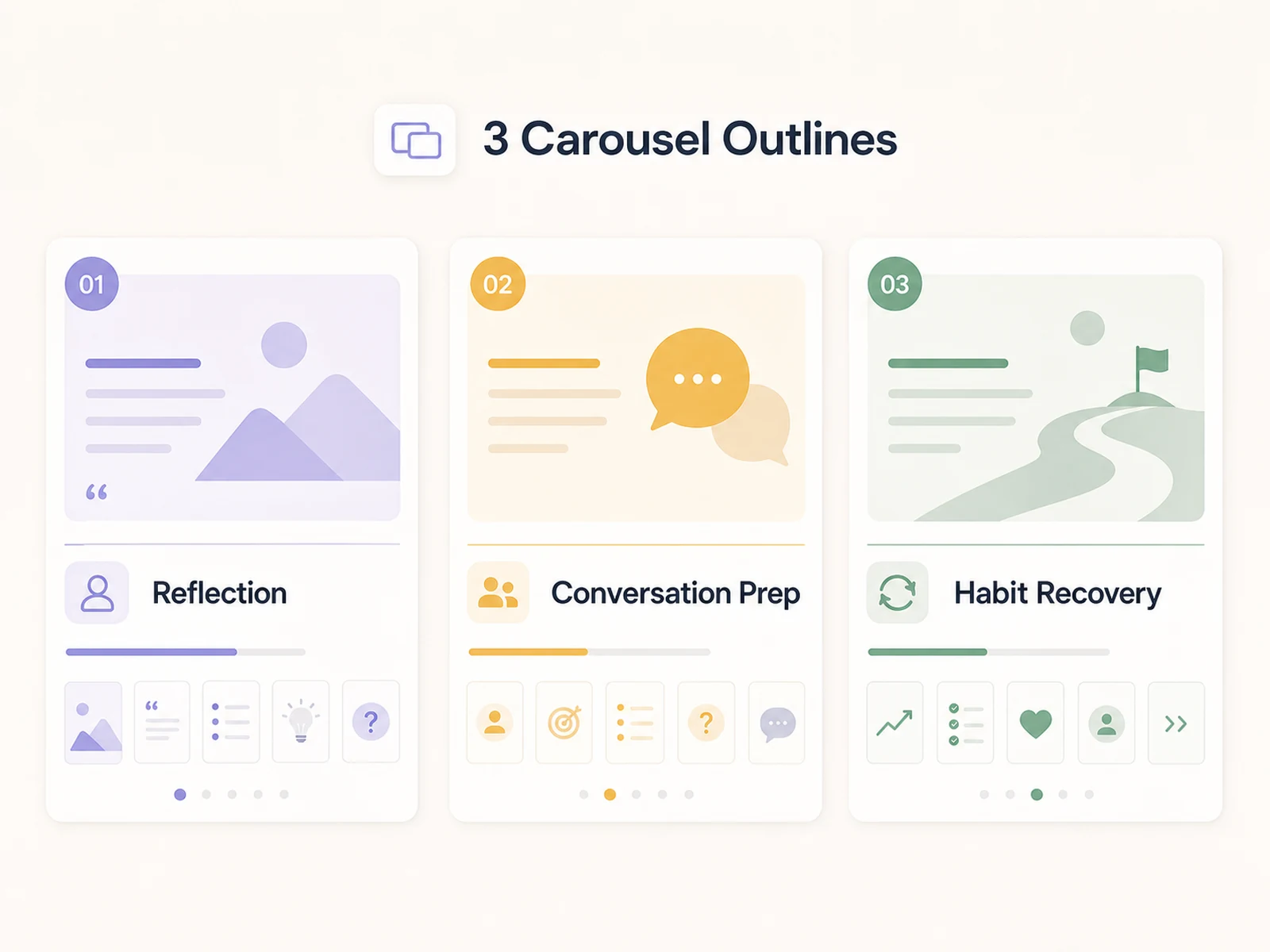
Three complete carousel outlines
Outline 1: “Reflection vs rumination”
| Slide | Content |
|---|---|
| 1 | You are not always overthinking. Sometimes you are using the wrong reflection loop. |
| 2 | Reflection asks: what happened? Rumination asks: why am I like this? |
| 3 | Reflection produces a decision. Rumination produces more self-criticism. |
| 4 | Reflection has a time box. Rumination has no finish line. |
| 5 | Try this: write the event, the lesson, and the next action. |
| 6 | If there is no next action, choose a recovery action. |
| 7 | Save this for the next time your thinking gets circular. |
Outline 2: “Preparing for a difficult conversation”
| Slide | Content |
|---|---|
| 1 | Do not script the whole conversation. Prepare the parts that matter. |
| 2 | Clarify the outcome you want. |
| 3 | Write the one sentence you need to say clearly. |
| 4 | List the facts, not the interpretations. |
| 5 | Decide what boundary or request you are making. |
| 6 | Prepare for two likely responses. |
| 7 | CTA: save this before your next hard conversation. |
Outline 3: “Habit recovery”
| Slide | Content |
|---|---|
| 1 | Missing one day is not the problem. Turning it into a restart is. |
| 2 | Habits fail when the recovery plan is missing. |
| 3 | Choose a minimum version before you need it. |
| 4 | Use a two-day rule only when it reduces shame, not when it creates pressure. |
| 5 | Track recovery speed, not perfection. |
| 6 | The goal is continuity, not a perfect streak. |
| 7 | What habit needs a recovery plan? |
Turn coaching frameworks into clear slide sequences.
How to use SlideDrift for coaching content
Paste rough session notes only after removing private or identifying details. Better yet, write a safe summary:
Audience: mid-career professionals
Goal: explain the difference between reflection and rumination
Tone: calm, practical, not therapy-speak
Avoid: private client details
Points:
- Reflection produces a next action
- Rumination repeats blame
- Time boxes help
- End with a simple exerciseSlideDrift can turn that into a draft carousel, then you can edit the language to match your coaching style.
Coaching content mistakes to avoid
- Posting inspiration without a practical next step.
- Using anonymized client stories that are still identifiable.
- Turning every post into a sales pitch.
- Using clinical language outside your scope.
- Giving one-size-fits-all advice when context matters.
- Overloading each slide with too much copy.
Final takeaway
Strong coaching carousels do not just encourage people. They help people think, decide, and act more clearly.
Use SlideDrift to turn one coaching framework or safe client lesson into a polished carousel.
Related reading
Before you publish, use the LinkedIn carousel checklist and confirm dimensions with the LinkedIn carousel size guide.
FAQ
What should coaches post on LinkedIn?
Coaches should post practical frameworks, reflection questions, decision tools, anonymized lessons, and useful before/after thinking patterns rather than only motivational statements.
Can coaches use client stories in carousels?
Only if the story is safe, non-identifying, and appropriate to share. When in doubt, use a fictionalized or generalized pattern instead.
What CTA works for coaching carousels?
A good coaching CTA usually asks readers to save a framework, answer a specific reflection question, or apply a small exercise.
Make your own carousel
SlideDrift drafts the slides from your text. You edit them, then export a PDF for LinkedIn.