LinkedIn Carousel Ideas for Therapists: 30 Ethical Psychoeducation Post Formats
30 ethical LinkedIn carousel ideas for therapists, counselors, and mental health professionals, with privacy guardrails and psychoeducation templates.

A strong LinkedIn carousel for therapists should educate without overclaiming, show expertise without sounding self-promotional, and give readers a practical way to understand a problem.
The safest and most useful approach is to publish educational, general-information carousels: frameworks, checklists, explainers, decision guides, myth-busting posts, and anonymized lessons. Avoid personalized advice, confidential details, exaggerated outcomes, or claims that your review process cannot support.
Compliance and professionalism note
The ACA Code of Ethics emphasizes client privacy and confidentiality, and HHS HIPAA guidance explains that protected health information has strict use and disclosure rules. For public LinkedIn content, therapists should avoid identifying client information, avoid diagnosing public readers, and avoid giving advice that could be mistaken for treatment.
This article is not legal, medical, financial, or professional compliance advice. Treat it as a content strategy guide and run sensitive posts through your own review process.

Review every mental health post for privacy, boundaries, and clarity.
What makes a good therapist carousel?
A useful carousel has five parts:
- A specific reader problem. The reader should know immediately whether the post is for them.
- A clear educational promise. The carousel should explain, compare, or simplify something.
- A practical structure. Use steps, examples, checklists, or decision trees.
- A professional boundary. Do not turn a public post into individualized advice.
- A low-pressure CTA. Invite saving, commenting, or asking a general follow-up question.
30 LinkedIn carousel ideas for therapists
Psychoeducation basics
- What boundaries are and are not — Hook: “A boundary is not a demand that controls someone else” Slide flow: define, example, common mistake, skill
- The difference between stress and burnout — Hook: “Burnout is not just needing a weekend off” Slide flow: compare, signs, what helps, caveat
- Why avoidance feels helpful short term — Hook: “Avoidance works until it starts running your life” Slide flow: mechanism, example, gentle skill
- What emotional regulation actually means — Hook: “Regulation is not pretending you are fine” Slide flow: definition, signs, practice
- Why naming feelings can help — Hook: “A feeling you can name is easier to work with” Slide flow: principle, examples, exercise
Skills and practices
- A simple grounding exercise — Hook: “When your thoughts speed up, start with the body” Slide flow: steps, when to use, caveat
- How to prepare for a hard conversation — Hook: “The first sentence is not the first step” Slide flow: goal, timing, script, repair
- A journaling prompt for patterns — Hook: “Do not just ask what happened; ask what repeats” Slide flow: prompt, example, reflection
- How to notice all-or-nothing thinking — Hook: “The word “always” is worth pausing on” Slide flow: signs, reframe, example
- A weekly self-check-in structure — Hook: “A check-in works best when it is specific” Slide flow: body, mood, stressors, needs
Therapy process explainers
- What to expect in a first therapy session — Hook: “The first session is not a test you need to pass” Slide flow: goals, intake, questions, next steps
- How therapy goals are set — Hook: “A therapy goal should be more than “feel better”” Slide flow: problem, behavior, measure, revisit
- What progress can look like — Hook: “Progress is not always feeling good every week” Slide flow: examples, setbacks, signs
- How to know a therapist fit is not right — Hook: “Fit matters, and it is okay to talk about it” Slide flow: signals, conversation, next step
- What confidentiality generally means — Hook: “Confidentiality has a purpose and limits” Slide flow: general note, why, ask your provider
Myths and misconceptions
- “Therapy is only for crisis” — Hook: “You do not need to wait until everything breaks” Slide flow: myth, reality, examples
- “Coping skills should work immediately” — Hook: “A skill can help without fixing everything instantly” Slide flow: expectation, practice, fit
- “If I understand it, I should be over it” — Hook: “Insight and change are related, not identical” Slide flow: explain, example, patience
- “Boundaries are selfish” — Hook: “A boundary can protect a relationship instead of ending it” Slide flow: reframe, example, CTA
- “I should be able to handle this alone” — Hook: “Independence does not mean isolation” Slide flow: normalize, support options
Professional audience posts
- How leaders can avoid accidental invalidation — Hook: “Supportive intent can still land badly” Slide flow: phrases, alternatives, example
- What workplaces misunderstand about burnout — Hook: “A wellness perk cannot fix a broken workload” Slide flow: pattern, signs, leadership questions
- How to make mental health content less performative — Hook: “Awareness posts are easy; safer systems are harder” Slide flow: principle, actions
- How professionals can protect decompression time — Hook: “Recovery time needs a boundary before it needs motivation” Slide flow: signs, calendar, script
- Why repair matters after conflict — Hook: “The repair conversation is where trust often changes” Slide flow: what repair means, steps
- How to talk about emotions without oversharing at work — Hook: “Emotional honesty still needs context” Slide flow: levels, examples, boundaries
- What managers can say when someone is struggling — Hook: “You do not need to be a therapist to respond humanely” Slide flow: listen, scope, resources
- How to make self-care less vague — Hook: “Self-care should answer a specific need” Slide flow: needs, examples, plan
Reusable carousel templates
Template: Normalize → Educate → Skill
- Use when: A common struggle needs gentle education
- Slide outline: Normalize the experience → explain the mechanism → give a general skill → note limits → invite reflection
- Save this as a reflection prompt.
Template: Myth → Reframe
- Use when: A harmful misconception is common
- Slide outline: Name the myth → explain why it sounds believable → offer a better frame → give example
- What would you add to this reframe?
Template: What to Expect
- Use when: Demystifying therapy or a process
- Slide outline: Set expectation → explain what usually happens → reduce fear → suggest questions to ask
- Bring this question to your own provider if relevant.
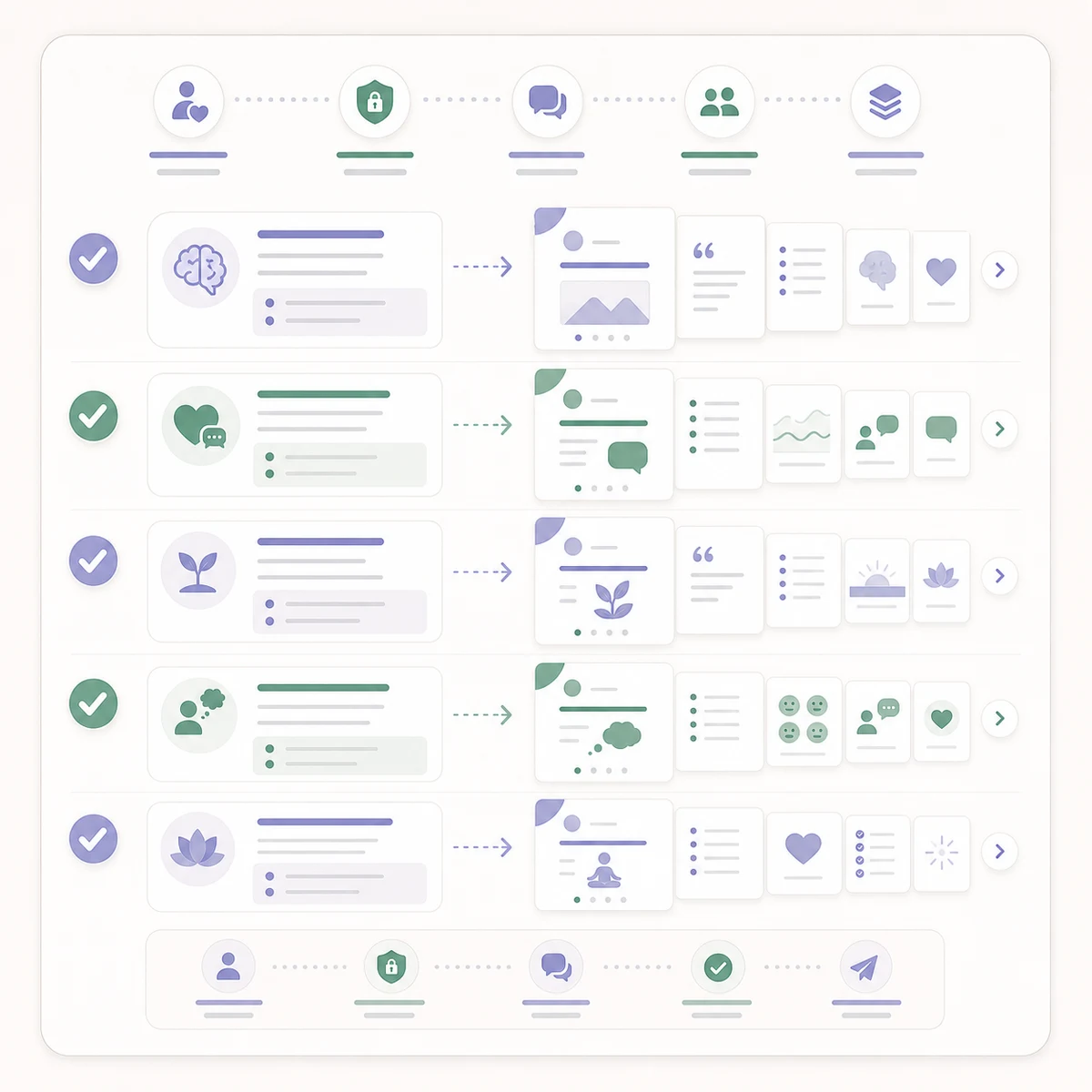
A safe psychoeducation post teaches one general concept clearly.
Mistakes to avoid
- Using a disguised client story that could still identify someone.
- Diagnosing readers from a public carousel.
- Turning crisis or trauma content into clickbait.
- Using therapy jargon without explaining it.
- Implying that one skill, modality, or post works for everyone.
How to create these faster in SlideDrift
Use SlideDrift when you already have raw material but do not want to manually design slides. Paste a rough outline, client-safe note, article URL, or educational draft into the create box. Add a short instruction such as:
Audience: therapists prospects and peers. Goal: explain one concept clearly. Tone: practical, careful, and not promotional. Avoid personalized advice or sensitive details.
Then review the generated deck. Delete anything that sounds like a claim you would not publish manually. Adjust the CTA. Apply a brand profile so the carousel matches your professional identity. Export as PDF when the deck is ready for LinkedIn.
A simple monthly plan
| Week | Carousel type | Example |
|---|---|---|
| Week 1 | Educational explainer | Define one confusing concept |
| Week 2 | Checklist | Help readers prepare for a common decision |
| Week 3 | Mistakes post | Show what people misunderstand |
| Week 4 | Framework | Share a reusable way to think about the topic |
That cadence creates consistency without forcing you into constant self-promotion.
Related reading
Before you publish, use the LinkedIn carousel checklist and confirm dimensions with the LinkedIn carousel size guide.
FAQ
Can therapists post mental health carousels on LinkedIn?
Yes, but posts should be general psychoeducation, not diagnosis or treatment of individual readers. Avoid client details, identifying stories, and advice that sounds personalized.
What should therapists avoid in LinkedIn carousels?
Avoid client stories without proper authorization, public diagnosis, oversimplified mental health claims, crisis instructions that replace professional help, and content that blurs boundaries with clients.
What topics work well for therapists?
General coping concepts, communication skills, therapy myths, boundary education, stress education, and “what to expect” process explainers can work well.
How can SlideDrift help therapists create carousels?
Therapists can paste safe psychoeducation notes into SlideDrift, generate a carousel, then carefully review language for boundaries, claims, and privacy before exporting.
Final recommendation
Use SlideDrift to turn safe psychoeducation notes into a clean carousel draft, then review the deck carefully before publishing.
Make your own carousel
SlideDrift drafts the slides from your text. You edit them, then export a PDF for LinkedIn.