LinkedIn Carousels vs External Links: How to Share Content Without Losing the Reader
Post a carousel when the lesson belongs in the feed and a link when readers must act elsewhere, plus what LinkedIn and studies say about links and reach.

Post a carousel when you want readers to get the lesson in the feed, and a link post when they need the destination to act: to sign up, buy, use a tool or read the full report. LinkedIn says it doesn't intentionally limit the reach of posts with links, while independent studies disagree on whether link posts reach fewer people. Either way, make the post useful before anyone clicks.
- Carousel: the lesson stays in the feed, as steps, a framework, a checklist or a report's main findings.
- Link post: the destination does the job, such as a sign-up form, a checkout, a tool or the full evidence.
- Both: the carousel teaches the main idea, and the link leads to the source for the detail.
Choose by the reader's next step
The choice isn't between reach and traffic. It's about where the value has to live.
| Reader's next step | Better format | What must be true |
|---|---|---|
| Learn a framework | Carousel | The slides teach the whole framework |
| Follow a step-by-step tutorial | Carousel | Each slide carries one clear step |
| Use a calculator or interactive tool | Link post | The destination does the useful work |
| Register, buy, apply or book | Link post | The action can only happen at the destination |
| Browse a resource library | Link post | The collection, not a summary, is the point |
| Understand a report's main finding | Carousel + link | The finding works alone; the report holds the evidence |
| Review a full case study | Carousel + link | The carousel teaches the pattern; the destination holds the full record |
Does LinkedIn limit the reach of posts with links?
LinkedIn says not on purpose. The independent evidence is mixed, and none of it puts a reliable number on what a link costs a post.
What LinkedIn says. In a September 2025 video shared by social media consultant Matt Navarra, Rishi Jobanputra, LinkedIn's Sr. Director of Product Management, said a link doesn't intentionally limit a post's reach when it supports the post rather than being its main point. His advice: "make sure your post gives enough context that it could stand alone without the link." LinkedIn's feed relevance help page says its algorithms filter out or taper the distribution of low-quality and unsafe content; it doesn't list links as a category.
What independent studies found. Three large datasets point in different directions:
- Socialinsider's 2026 LinkedIn benchmark, based on 1.3 million posts from 16,645 business Pages, measures engagement per impression. Link posts had the lowest average rate of any format in 2025, 3.25% against 7.00% for native documents, and still trailed in Q2 2026, 3.30% against 6.60%. That shows how people responded to the posts they saw, not how many people saw them.
- LinkPost's 2026 study of 358,021 posts (62% in French) from 30,843 profiles found a lower median reach for posts with links: 448 impressions, against 705 for posts without. Its authors call this a correlation: LinkedIn may show link posts less, or weaker promotional posts may be the ones carrying links.
- Metricool's 2026 LinkedIn study of 673,658 posts from 63,108 accounts found a split. On Company Pages, posts with links performed above average for impressions and interactions; on personal profiles, both dropped.
All three compare different posts, not the same post with and without a link, so none can show what adding a link does to yours. Treat any reach figure you see quoted as one dataset's average, not a rule.
What to do with that. Whatever the size of the effect, the safe move is the one LinkedIn recommends: make the post worth reading without the click. A post that only says "new article is live" and adds a URL gives the feed little to respond to. Lead with the core argument, the key finding, the checklist or the mistake the article explains, and let the link be the next layer.
When a link post is the right choice
Don't avoid links as a rule. Post the link when:
- the goal is a sign-up, a sale or a booking;
- the destination is an interactive tool;
- the reader needs the full report, terms or evidence;
- you're promoting an event registration page;
- the material is too detailed to summarize well.
Say what the reader gets after the click, and give enough of the point first that the post stands on its own.
When a carousel works better
Use a carousel when the source holds a structured idea the reader can take away without clicking:
- a blog post with five sections becomes a five-part carousel;
- a research report becomes its main findings and what they mean;
- a product guide becomes a step-by-step walkthrough;
- a founder essay becomes a set of lessons;
- a newsletter becomes a checklist.
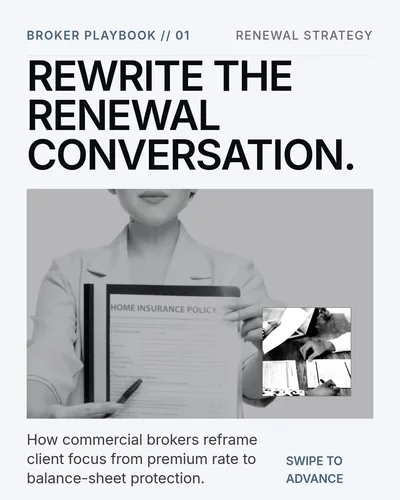
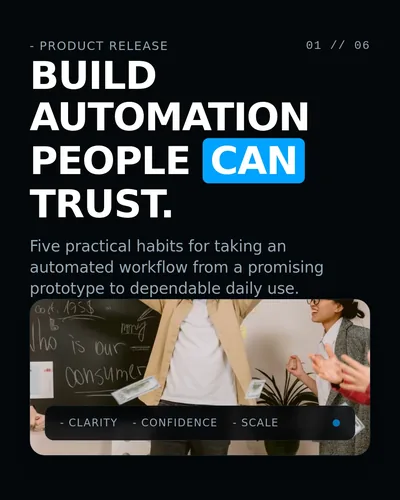
The carousel needs enough substance to justify the swipe; a teaser split across eight slides is still a weak post. Open with a specific promise, as in these first slide examples.
Use both: decide what goes where
For reports, guides and product education, a hybrid often fits best: the carousel teaches the main idea, and the link leads to the source, tool or full detail. Before you write either, separate what the post must teach from what the destination must add.
Reusable brief
Native-value and destination-value brief
- Post objective: the one action you want after the post: learn, save, discuss, visit, register or buy.
- Native promise: the useful result someone gets without leaving LinkedIn.
- Native proof: the three to five points, examples or steps that deliver that promise.
- Destination-only value: what genuinely needs the link, such as an interactive tool, the full source, a registration form, a detailed template or a product walkthrough.
- Call to action: the extra value after the click, instead of "read more."
- Measurement pair: one native signal and one destination signal, chosen before you publish.
If you can't write a useful native promise, post the link with a clear explanation of the destination. If the destination-only value is empty, the carousel probably doesn't need a link.
Worked example: the document post guide
The LinkedIn document posts guide has both layers: a six-slide carousel and the full article behind it.
The brief applied to the document post guide
| Brief field | Decision for this article |
|---|---|
| Post objective | Teach what a LinkedIn document post is and when the format fits. |
| Native promise | Understand the format, when to use it, why it works and what to check before posting. |
| Native proof | Six slides: the definition and upload limits, when to use one, why it works, what to check, and a plan-design-post close. |
| Destination-only value | The posting steps for desktop and mobile, a page-by-page structure, a pre-post checklist, source links and how to make one in SlideDrift. |
| Call to action | Open the full guide for the posting steps and checklist, not to read the carousel again. |
| Measurement pair | Saves or sends for the carousel, then visits to the link for the article. |
The six slides teach the core idea; the article holds the steps and evidence that would make the deck too dense.
Turn an article into a carousel
- Choose one article, not a whole website.
- Name the reader who'd benefit from it.
- Pull out the five to eight points that make one complete lesson.
- Put them in order, one point per slide.
- Give each slide an example or a decision.
- Keep the link for the evidence, tools, templates or depth the slides can't carry.
In SlideDrift, open Create and paste the article's public URL on its own: SlideDrift reads the page and drafts an editable carousel. To steer the result, paste the article's text with a brief instead:
SlideDrift brief
Turn the article below into a 6-slide LinkedIn carousel.
Teach its main lesson on the slides, one point per slide,
so a reader gets it without clicking.
End with one line on what the full article adds.

[Paste the article text here]Edit the draft, then choose Share, then Export, and download the PDF for LinkedIn. If SlideDrift can't read a page, for example because it sits behind a login, paste the text instead. The URL-to-carousel guide covers each step.
Turn an article into a carousel
Paste your article's link or text. SlideDrift drafts the slides, you edit them, then export the PDF for LinkedIn.
Before you publish, run the LinkedIn carousel checklist.
How to measure the choice
LinkedIn's post analytics show impressions, members reached, reactions, comments, reposts, saves and sends, plus profile viewers and followers gained from the post. For external links they count visits to links in the post, except for links flagged as spam or malicious and links to content on LinkedIn. LinkedIn notes the numbers are estimates.
Choose a pair that matches the two jobs:
- Teaching in the feed: saves or sends, plus relevant comments.
- Sending readers on: visits to the link, then the result you track at the destination.
- Building authority: profile viewers or followers gained, plus real conversations.
Don't grade both formats with one blended score. A carousel can succeed at reuse while the linked article fails to convert, and a link post can bring useful visits without many public reactions. The carousel measurement guide has a 30-day tracker for keeping those comparisons consistent.
Common mistakes
- Pasting the whole article into slides. Pick one lesson and cut the rest.
- Hiding the whole lesson behind the link. Give the key point in the post.
- A teaser carousel. Slides that only say "read more" waste the swipe.
- Treating a benchmark as a forecast. A format average or a quoted reach figure doesn't predict your next post.
- Burying the next step. If you move the link to the comments, check that readers can still find it.
FAQ
Does LinkedIn penalize posts with external links?
LinkedIn says it doesn't intentionally limit the reach of posts with links, and advises writing posts that could stand alone without the link. Independent studies disagree on whether link posts reach fewer people, so treat any reach figure as one dataset's average, not a rule.
Are LinkedIn carousels better than link posts?
For teaching, they're usually the better fit, because the lesson stays in the feed. In Socialinsider's benchmark of business Pages, native documents averaged more than twice the engagement rate of link posts in 2025. When the reader has to act at the destination, post the link.
Should the link go in the post or in the comments?
LinkedIn's advice is about the post, not the link's position: make the post stand alone without the link. If the link is the next step, keep it where readers will see it. If you try the comments, use a tracked link so you can compare visits.
Can I turn a blog post into a LinkedIn carousel?
Yes. In SlideDrift, paste the article's public URL into Create and it drafts an editable carousel. Edit the slides so they teach one complete lesson, then export the PDF.